 UnifiedAcupunctureTheory
Level 1 · In person
Applied Nanjing
The four-needle approach, guided by the abdomen.
Formerly SAAM acupuncture with abdominal palpation, then 4 Needles 5 Elements and Applied Nan Jing Acupuncture – Level I.
The Nanjing, the Classic of Difficulties, holds one of the most elegant ideas in acupuncture: every channel carries all five elements, and four well-chosen points can strengthen or calm an element. In this course we bring the Sa'am four-needle approach together with abdominal palpation, and with the channel interactions of Dance of the Channels. That last part is what makes the way I teach it different: the interactions give you another way of using the four needles. It is especially useful for Zang-Fu patterns and for emotional wellbeing.
- Format
- In person, with live demonstrations and practice
- Length
- 2 days
- For
- Acupuncturists and advanced students of acupuncture. Also shiatsu practitioners and kinesiologists with a basic knowledge of the channels and where they run.
- Certificate
- Attendance certificate for CPD (2 days, 14 hours)
- Level 2
- Leads on to Advanced Applied Nanjing
The method
Three steps to every treatment
The abdomen tells you where to start. The elements tell you what to do. Four needles do the rest.
- Palpate the abdomen Each organ has its reaction zone on the abdomen. What you feel there shows which element is out of balance.
- Tonify or disperse Decide whether the element needs strengthening or calming, and whether to work on its yin or its yang channel.
- Place four needles The Sa'am four-needle combination, chosen for the pattern you found on the abdomen.
Applied I Ching or Applied Nanjing?
The vessel and the transformation
Both courses are used for internal disorders, so the question often comes up: what is the difference? They answer two sides of the same process.
Applied I Ching
The vessel
The structure, or container, in which change can happen. The twelve patterns build a vessel that holds the patient while they move through what they are going through.
Applied Nanjing
The transformation
The process of change itself. The four needles work directly with what is weak or too strong, and help it transform.
This course
The same idea runs through Tracing Your Deep Song, where we speak of the vessel and the prima materia.
What makes this course different
Four needles, and the channels that answer them
Many courses teach the Sa'am four-needle approach. What is particular here is that it is taught through the channel interaction systems of Unified Acupuncture Theory, the same systems at the heart of Dance of the Channels.
The classic four-needle combinations stay the foundation. Where the interactions come in is with complex abdominal patterns, when more than one channel is affected. Instead of treating each one separately, you look for a single channel that interacts with all of them, and treat that one, with the fewest needles possible.
You don't need to have taken Dance of the Channels first. The channel interactions this course uses are taught within it. If you have taken it, you will recognise them, and see them used in a new way.
What you will learn
“When it is empty, tonify the parent. When it is full, drain the child.”
- Yin, yang and the five elementsYin and yang as the I Ching describes them, through the seasons and into the elements, with Heaven as the sixth distinction.
- The two cyclesHow the elements nourish and control one another, and how each is influenced by, and has an influence on, the others.
- The five-element pointsThe five-element points on every channel, and how they are used.
- Tonification and dispersionHow to needle to strengthen, and how to needle to calm.
- Abdominal palpationHow the abdomen shows which element needs attention.
- The emotions of the elementsEach emotion has a function. How the five and a half emotions show where an element is struggling, and how the patterns support emotional wellbeing.
- The patternsPatterns to tonify and to disperse, for the yin and the yang elements.
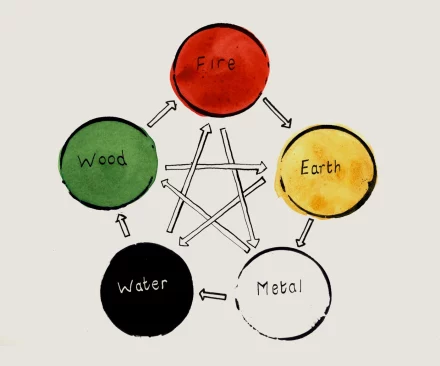
The map behind the needles
Parent and child
Around the circle, each element nourishes the next, as a parent feeds a child. Across the star, each element keeps another in check. The four needles work with both movements at once: they feed what is weak from its parent, and calm what is too strong through the element that controls it.
Illustration from Sun's Season of Channels.Dates for this course
All courses in the calendar-
7–8 Nov 2026
In English CHF 495Register
-
30–31 Jan 2027
Brisbane, Australia Organised by NeedlePro Australia (Sohial Farzam) Organised as ‘SAAM Level 1 Acupuncture (4-day seminar)’In English AUD 1,895 · 4-day seminar with Dance of the Channels. Taken it before: AUD 1,231.75.Register
-
6–7 Feb 2027
Melbourne, Australia Organised by NeedlePro Australia (Sohial Farzam) Organised as ‘SAAM Level 1 Acupuncture (4-day seminar)’In English AUD 1,895 · 4-day seminar with Dance of the Channels. Taken it before: AUD 1,231.75.Register
No date near you yet? Tell me where you are, or bring a course to your country.
This course counts towards the UAT Practitioner certificate. See the certification pathway.
What practitioners say
“I love every moment! Each time I am attending I get surprised by the high level of teaching, the practical application of it in the clinic.”
Questions
Do I need to know the five elements already?
A basic knowledge of the channels and where they run is enough. Yin and yang, the seasons and the five elements are taught from the beginning. The course is open to acupuncturists, advanced students of acupuncture, and shiatsu practitioners and kinesiologists with that grounding.
Do I have to take the courses in a set order?
No. The three Level 1 courses can be taken in any order. I recommend starting with Dance of the Channels, because this course uses the same channel interactions in a new way. If you start here, the interactions you need are taught within the course.
Will I get a certificate?
Yes, an attendance certificate for your CPD, for 2 days (14 hours) of teaching.
Is there a next step?
Yes. Advanced Applied Nanjing goes deeper into the theory and into complex cases. It is always in person, and open once you have taken this course.